7 Medical Assistant Program Lengths Explained

Last Updated: November 15, 2026
Quick Summary
Medical assistant program length depends on the credential: most certificate and diploma programs take 9 to 12 months, while an associate degree runs about 18 to 24 months. At Life Vest Training in Petaluma, California, our medical assistant program takes just 7 weeks.
Certificate programs typically run 9 to 12 months of full-time study.
An associate degree in medical assisting usually takes 18 to 24 months.
Part-time schedules and externship hours can stretch your real finish date.
Life Vest Training's 7-week track includes textbooks, lab supplies, and CPR certification.
Life Vest Training is an official CA regional testing site, so graduates test where they trained.
How fast can you become a medical assistant?
Life Vest Training offers a 7-week medical assisting track with hands-on labs and all-inclusive tuition in Petaluma.
Table of Contents
How Long Medical Assistant Programs Take by Credential Type
Medical assistant program length depends on the credential you choose. Most students finish a certificate or diploma in 9 to 12 months, while an associate degree takes about 18 to 24 months. At Life Vest Training in Petaluma, California, our medical assistant program runs 7 weeks, which puts you in a clinical setting faster than a traditional track.
That short timeline is the whole point. You get the same core skills, just without two years of general education courses stacked on top.

Certificate and Diploma Timelines
A certificate program is the shortest standard route. Most run 9 to 12 months of full-time study, and some diploma programs land in the 4 to 9 month range when they skip general education.
These programs focus on what you actually do on the job:
Checking vital signs and recording patient history
Drawing blood and handling specimens
Managing appointments and medical records
Assisting with exams and minor procedures
The trade-off is clear. You start earning sooner, but you earn a credential rather than a degree.
Associate Degree Timelines
An associate degree in medical assisting usually takes 18 to 24 months. The extra time covers general education classes plus deeper clinical coursework.
Who should pick this route? Students who want a degree on paper for future advancement, or who plan to transfer credits toward a bachelor's. If your goal is to work as a medical assistant next year, the degree path is slower than it needs to be.
Certificate vs Associate Degree: A Timeline Comparison
The fastest route to work is a certificate, and the longest is an associate degree. Here is how the two compare on the factors that matter most.
Factor | Certificate or Diploma | Associate Degree |
Typical completion | 4 to 12 months | 18 to 24 months |
Focus | Hands-on clinical and admin skills | Skills plus general education |
Entry into the field | Fastest path | Delayed by a year or more |
Best for | Career changers, quick entry | Students planning further study |
Schedule flexibility | Often part-time or hybrid | Usually structured, daytime |
Neither option is "better" in a vacuum. A certificate gets you hired; a degree gives you room to grow later.
What Affects Medical Assistant Program Length
Two programs can both advertise "9 months" and still finish months apart in practice. The headline number is a baseline, not a promise. Here is what actually moves the finish line, and how to read each factor before you enroll.
Credential type: A certificate or diploma sets the shortest baseline, an associate degree the longest. This is the one factor you choose up front, so pick it against your goal, not the brochure.
Full-time vs part-time: A part-time schedule takes longer to complete because you take fewer courses per term. If you work full-time, ask how many terms a part-time track adds before you commit.
Format: Hybrid and online coursework can compress the classroom portion, but hands-on labs and externships are fixed in length. A hybrid program does not shorten the clinical hours; it only changes where the bookwork happens.
Externship hours: Required clinical experience adds weeks that vary by program and by site availability. This is the most common hidden stretch.
Prerequisites: Some programs require courses or health screenings before your first class, which pushes your real start date back even if the program itself is short.
Cohort start dates: A program that only starts twice a year can leave you waiting months after you are ready. Frequent start dates shorten the real calendar timeline more than a shorter program with one annual intake.
One detail worth checking: whether a program uses hybrid medical assistant programs in California that blend digital coursework with in-person labs. Hybrid formats often let working adults keep a job while training, which changes the real-world timeline more than the brochure number does.
Watch out: a program that advertises a short length but pushes the externship to the end can leave you waiting months to finish. Ask when clinical hours start and whether externship sites are confirmed at enrollment or assigned later.
For students in Petaluma and the surrounding North Bay, commute time is its own factor. A program 45 minutes away in Marin County can add hours a week that a closer Petaluma option does not, and those hours come out of study or work time.
Accelerated Medical Assistant Programs: The Fastest Route
Accelerated medical assistant programs compress training into weeks rather than months. These tracks cut electives and general education, then front-load clinical skills so you graduate job-ready.
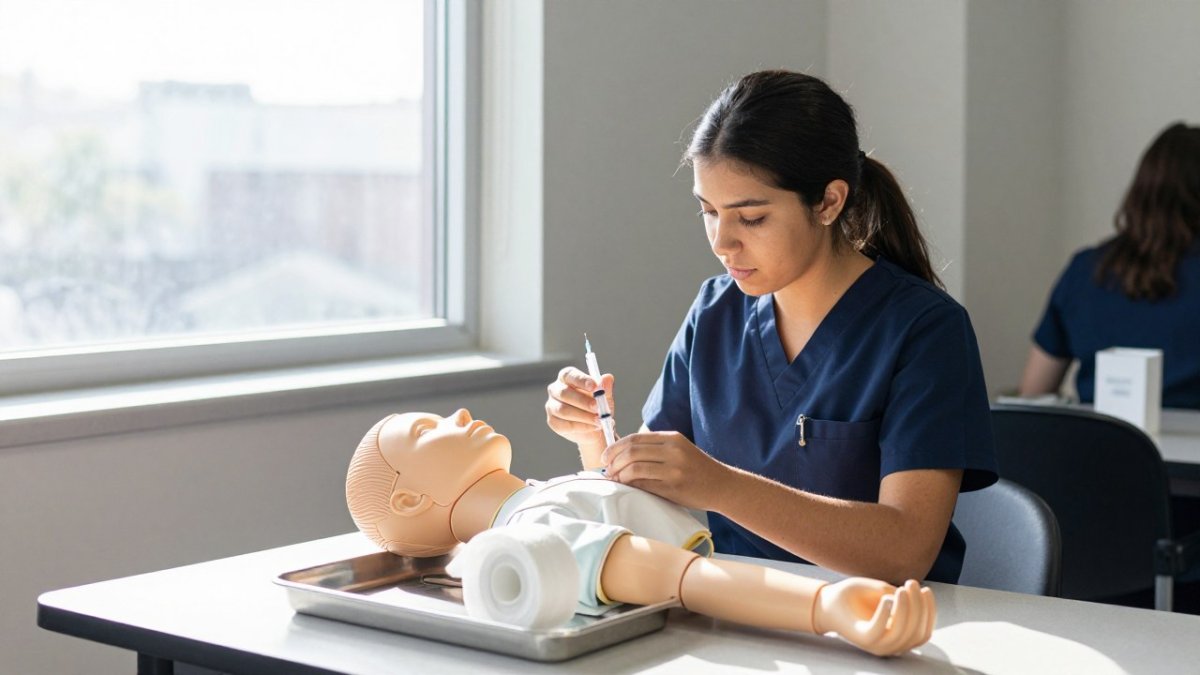
Life Vest Training runs a 7-week medical assisting track built exactly this way. Coursework is delivered digitally, and hands-on labs happen in person so you practice real skills, not just watch videos.
The all-inclusive tuition covers textbooks, lab supplies, and CPR certification. If your goal is to enter healthcare this season rather than next year, this is a focused, accelerated route. You can read more about becoming a medical assistant in under 7 weeks to see how the schedule works.
Is 7 weeks too fast to learn anything real? No, because the training is focused. You are not studying poetry alongside anatomy. Every hour goes toward the skills you will use in an exam room.
Medical Assistant Program Requirements Before You Enroll
Most medical assistant programs ask for a high school diploma or equivalent, and some require a background check before clinical placement. Beyond that, requirements vary, so confirm the details before you commit.
Here is a practical pre-enrollment checklist:
Confirm you have a high school diploma or GED
Ask whether a background check or health screening is required
Check the schedule and confirm it fits your work hours
Understand exactly what tuition covers, and what it does not
Ask about the certification exam and how the program prepares you
Confirm the program's testing site status
That last point matters. Life Vest Training is an official CA regional testing site. Before you enroll anywhere, review the medical assistant certification cost breakdown so you know the full financial picture, not just tuition.
Medical Assistant Certification in California: Timeline to Credential
California does not require medical assistants to hold a state license, but most employers prefer or require a national certification. That credential signals you met a training standard, and the timeline to get it is more predictable than most guides admit.
The sequence runs in five steps:
Finish your program and receive your certificate of completion.
Register for the certification exam. Registration timing depends on the certifying body and on whether your program is an approved testing site.
Sit for the exam. Students who test where they trained avoid the wait for an outside exam slot, which is often the longest hidden delay.
Receive your results and credential. Results typically come back within weeks, not months.
Apply for jobs with certification in hand. Employers can verify your credential, so having it before you interview shortens the hiring conversation.
Because Life Vest Training is an official CA regional testing site, our graduates test in a familiar setting rather than hunting for an outside exam location. That single detail can remove weeks from the graduation-to-credential gap.
Before you enroll anywhere, confirm three things: that the program is approved for the certification exam you plan to take, that it arranges externship placement rather than leaving you to find it, and that it publishes current start dates. You can check current requirements through the California Department of Public Health and confirm national certification details with the certifying body. Review the medical assistant certification cost breakdown so you know the full financial picture, not just tuition.
The piece most guides skip: the gap between graduation and first paycheck is usually the job search, not the training. Starting certification prep early, and testing where you trained, shortens that gap. If you are in Petaluma or anywhere in the North Bay, our team can walk you through the certification sequence and the next start date so you can plan the whole timeline, not just the classroom weeks.
From Application to First Job: The Full Timeline
Total time from application to first job breaks into four phases: enrollment, training, certification, and job search. For an accelerated program, that whole arc can fit inside a single season.
Application and enrollment: Days, not months, for most programs.
Training: 7 weeks in an accelerated track, or 9 to 24 months in a traditional one.
Certification: A few weeks after graduation to test and receive results.
Job search: Varies, but entry-level medical assistant roles are in steady demand across hospitals and clinics.
If you are planning your start date, look at the medical assistant class schedule to pick a cohort that lines up with your timeline.
The piece most guides skip: the gap between graduation and first paycheck is usually the job search, not the training. Starting certification prep early shortens that gap.
Claim Your Seat in a 7-Week Medical Assisting Track
Here is the challenge: every month you wait is a month of healthcare wages you are not earning. The good news is that the timeline is in your hands. A focused, accelerated program removes the years of waiting that keep people out of healthcare careers.
Life Vest Training is built for exactly that. Our 7-week medical assisting track combines hybrid learning with hands-on labs, all-inclusive tuition that covers textbooks, lab supplies, and CPR certification, and official CA regional testing site status. Our program provides real-world tools for workplace readiness and an essential foundation for nursing school applicants.
If you live near Petaluma or anywhere in the North Bay and want to start a healthcare career without a two-year detour, we are ready when you are. Get started with Life Vest Training and claim your seat in the next 7-week cohort.
Ready to stop researching and start training? Our next medical assisting cohort is filling now, and your seat is one application away.
Frequently Asked Questions
How long are most medical assistant programs?
Most medical assistant programs run between 9 and 12 months for a certificate or diploma, while associate degree programs take about 18 to 24 months. Accelerated tracks can finish in as little as 4 to 9 months. The right length depends on whether you want to enter the workforce quickly or earn a degree that may support later advancement into roles with more responsibility.
What is the fastest you can become a medical assistant?
Accelerated medical assistant programs can get you trained in roughly 4 to 9 months, and some intensive tracks move faster. Life Vest Training's 7-week Medical Assisting track combines hybrid coursework with hands-on labs. After finishing, you sit for certification and start applying, so total time from day one to first paycheck can be under a year.
How long does it take to become a medical assistant in California?
In California, a certificate or diploma program typically takes 9 to 12 months, and an associate degree takes about 18 to 24 months. Accelerated options can finish in a few months. After training, you pursue medical assistant certification in California and begin your job search. Choosing a program that includes exam preparation and hands-on labs shortens the gap between graduation and employment.
Can you work while completing medical assistant training?
Yes, many students keep working during training. Hybrid learning models pair online coursework you complete on your own schedule with scheduled hands-on labs, so you are not driving to campus every day. Part-time and evening options add flexibility. Ask each program how many in-person lab hours are required per week before you enroll so you can plan around your job.
Questions? Talk to Life Vest Training


Comments